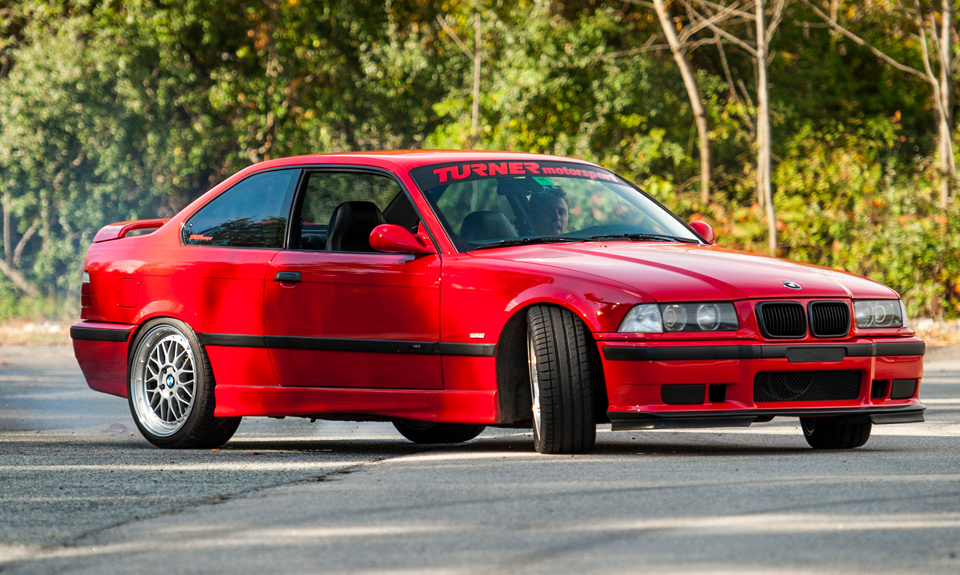
The E36 replaced the E30 in 1992 with its first version and was updated in 1995 with some slight visual and mechanical changes, but was otherwise an unchanged generation from its first production year to its last in 1999. Like the E30, the E36 saw a number of variants and trims that include a few engines and chassis layouts.
The engines available were the 4-cylinder M42 and the 6-cylinder versions known as the M50B25, M52B25, M52B28, S50B30, and S52B32.
In America, the 318i and 318ti were the 4-cyl versions available as the coupe (318i) and compact (318ti). These are the most ‘entry level’ of E36s, but can still be loads of fun, especially if you have plans for an engine swap in the future. A notable model to keep in your sights if you want a cool 318ti is a California-top model with the retractable canvas roof.
The next step up is the 325i, which had the M50B25. The 6-cylinder is popular as a donor engine to many vintage BMWs but holds its own well in the bulkier E36.
The 325i was succeeded by the slightly more powerful M52B28-equipped 328i in 1995, which offered a larger displacement 6-cylinder engine, VANOS, and updated looks. These cars also were OBDII. A 323i model was also available with a slightly smaller M52B25 that kept the 2.5-liter displacement.
The E36 M3 is the highest trim package available and the successor to the old E30 M3, but only according to some. The M3 received either the OBDI S50 in 1995 or the OBDII S52 for the rest of production. They were high-revving, large displacement, straight-sixes that were hell-bent on doing away with the lack of power associated with its predecessor. While the USA only got the ‘baby’ engines, the M3 was still an incredibly competitive car in its day and remains the most desirable of the chassis.
The body variants available are the coupe, sedan, convertible, and compact here in the United States, while the rest of the world received a touring (wagon) and a Baur edition retractable top sedan.
While not everyone searching for their next project, daily, or track toy will necessarily settle on the M3 as their E36 of choice, we are going to focus primarily on the M3 versions for the purposes of this article.
The first things to consider about your purchase will be what you need from your E36, how much work you are willing to invest, and the region from where you will buy the car. E36s are still ‘new’ enough that you may find some used car dealer listings. We are going to make a blanket statement and tell you to avoid those. Ordinarily, those cars will not have the best history nor will they be offered at the lowest prices.
Once you have decided what kind of E36 you want, you can begin your actual search. In our case, we are going to consider an M3 Coupe with the later model S52B32 and a 5spd manual transmission. These cars were offered in sedan and convertible as well, with automatic transmission options. As we learned from Don Salama, the coupe is a preferred model to outfit for racing. The wheelbase and track width between the three versions are identical, but the coupe is the lightest of the three. We would advise anyone looking for a car to daily, modify, track, or show to heavily consider the E36 M3 coupe thanks to its complete versatility. It really is a car for everyone, which explains its much higher production numbers and a greater number of variants over its predecessor.
With the E36 M3 coupe in mind, the search can begin for one that meets your expectations and requirements. These cars are now approaching 25 years old so rust, poor maintenance history, and high-mileage wear will be your primary concerns. Like the E30, we suggest finding a car with greater than 150k miles. Our reasoning, once again, is that the E36 models that are lower mileage will fetch premium prices but often require many costly services since they reach a critical point in their overall mechanical service lives around 100k miles. To avoid paying a premium for a car that is under 100k miles unless you have verified service history for all major functions.
This brings us to the actual car itself. If you found an E36 that is to your liking online, you should contact the seller and find as much history as you can. Since these cars depreciated completely in the previous decade, many models will have a history with several owners and may have been modified, rebuilt, or otherwise tampered with during their two-decade life. We encourage you to find one that is stock and unmodified, has a low number of owners, and as much service history as possible. Your checklist should include:
Obtaining a Carfax or Autocheck
All service records/receipts
Ask the owner what services he has completed
Ask if the car has ever been on a track
If the Carfax shows accidents, odometer discrepancies, or an otherwise branded title, just go ahead and walk away unless you are prepared to be the car’s final owner. Remember, you want the best example you can find for the money, especially if your intention is to track the car.
If the car has no service records, you will need to pay extra close attention during your inspection of the car if it is still to your liking. Definitely don’t walk away over a lack of service history, but bear in mind that some of the services the seller may say they’ve performed could be entirely fictitious.
If the car has been tracked in the past, you can bet two things: the owner drove the hell out of it and the owner probably maintained it pretty well. This is at your discretion. If you are hoping for a track car, you may luck out and some of the necessary modifications could already be in place or available to purchase with the car. If not, you may want to avoid a chassis that has already been stressed after a life on the road and transitioned to the extreme conditions found on the track.
With your new information in hand, an appointment with the owner to drive the car, and a bill of sale handy, it is time to get ready for your physical inspection and test drive. You should get a jack, jack stands, and a flathead screwdriver to take with you for the inspection. Remember, these are old cars so they can have many hidden issues. No one will chastise you for asking to lift the car up to see underneath and test out some of the suspension components during your inspection. You want to check as much as you can as to avoid any future surprises should you take the car home.
Exterior
Once you are standing face to face with the car, you can begin poring over it for imperfections.
Check the paint for blemishes/fading/peeling in either the paint or clear coat.
Make sure the bumpers don’t have an unreasonable gap. This could indicate the car has been in a minor or major collision. See if anything trim-wise is missing like the corner lights, side indicators, mirror caps, door trim, door handle bezels, and other small beauty pieces. They are sometimes a pain to source and better to have off the bat than to try and source.
Check the function of the windshield wipers, headlights, tail lights, fog lamps, indicators, and brake lights. E36s have notoriously breakable everything. Again, none of these pieces are particularly difficult to find, but the little things add up. Additionally, the number of little functions that are working as they should tell you a lot about how the owner cared for the car. If all the lights work and the trim is all there, you can bet the owner meticulously maintained the vehicle inside and out.
Look at the wheels and see if they are the OEM factory wheels or if they have been sneakily swapped for replica versions. Many OEM replica wheels exist and are cheap alternatives to buying the real deal wheels, so checking the wheels is important. This is also a great time to check the thickness of the brakes, check the rotors for lips or grooves, and inspect the condition of the tires.
Next, take your jack and jack stands and lift the front of the car in the air at the front jack points and support the car on the subframe. Before you crawl under the car, check each wheel for any play by placing your hands opposite each other on the rim flange of the wheel and press back and forth. You should not be able to shake the wheel without the rack turning. Any play will indicate failed suspension components or a failed steering rack.
Undercarriage
Next, crawl under the car. Check the ball joints on the outer tie rods and front control arms for tears or wear. Then look at the steering rack and dust boots. There should be nothing leaking here, but power steering leaks are common. Follow the power steering hoses up as much as you can to see if they are wet or coated in grime, as this could indicate a leak further up the line or at the reservoir.

Look at the sway bushings and end links to see if they need to be replaced. They most likely will since they are not a high-priority item in most casual driver’s minds.
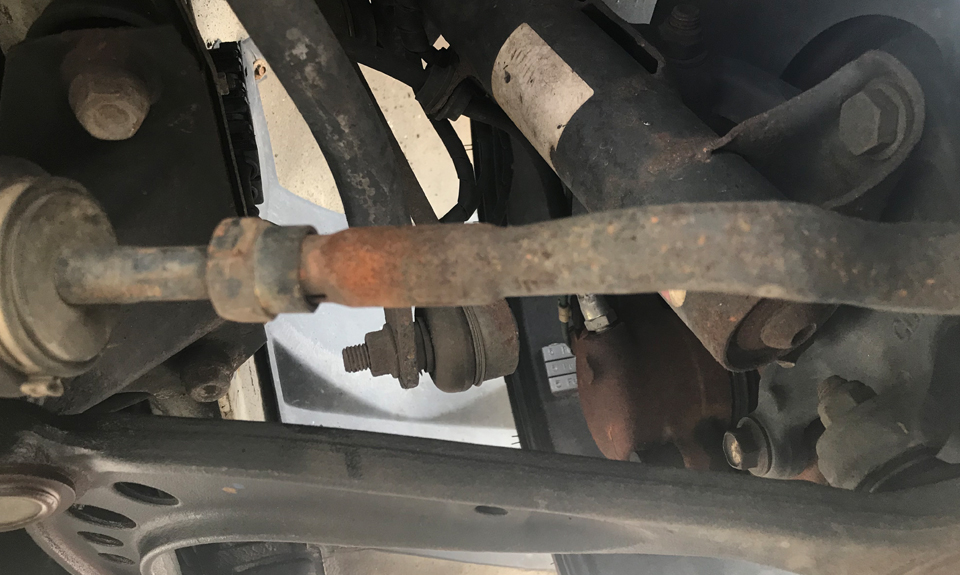
While you are still on the ground, look for leaks around the oil pan, down the block, and under the car in general. BMWs have notoriously weak cooling systems that fail in all kinds of fun ways, so a coolant drip is entirely possible. Same for oil, as pan gaskets, valve cover gaskets, and head gaskets could all still need to be replaced. If that is the case, you may see some steady oil seepage. These jobs are not difficult, even for beginners, and all the parts you need to tackle the maintenance can be found with us. Keep in mind, however, that these leaks tell you a lot of work is needed for the car and that can affect your purchase decision.
After inspecting under the car for leaks and testing the front suspension, you can put the car back down on the ground.
Interior
Open the doors. All door handles, inside and out, should work. However, on the E36, failed inner and outer door handles are common. Test out the locks and central locking as well. In opening all the doors, trunk, and testing the locks, look for any paint blemishes, dents, dings, or scratches. Everything you find can help in your price negotiation should you decide to make an offer. Bring them up to the owner casually as you find them.
Get in the car and begin inspecting the interior. Look for missing trim pieces. Check all the buttons, knobs, and the radio to make sure everything works. Window regulators, window switches, and other interior functions are known to fail. Having as much work as possible is better for obvious reasons.
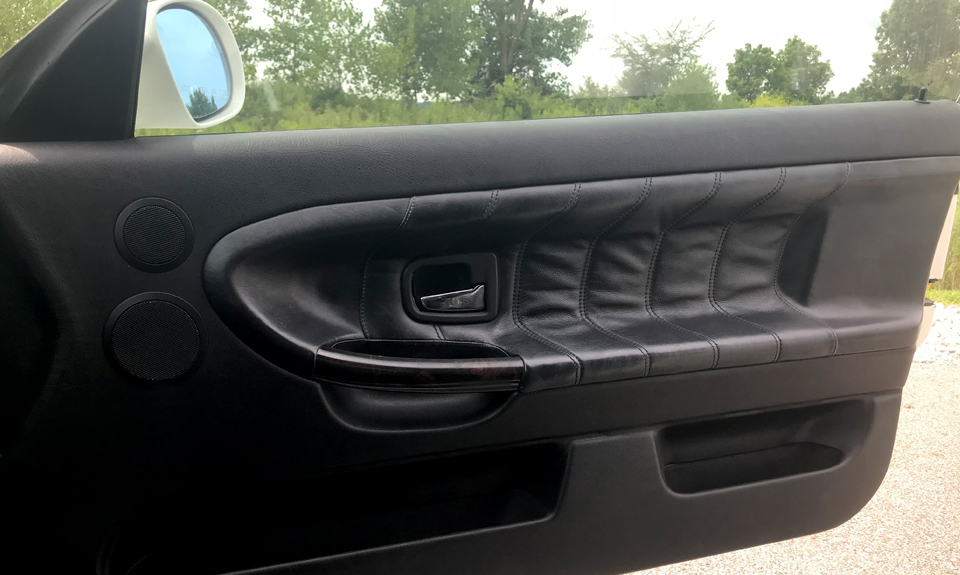
Look at the door cards, A, B, and C pillars, and headliner for issues. Door cards notoriously fall out and the rest are prone to sagging or being ripped out entirely. While all of this is easily fixable, it is great to mention to the seller anytime you find broken or destroyed parts of the car to help lower the price.
You should also pull up the carpet a bit and check for rust. The drain plugs behind the driver and front passenger seats are prone to rust. Look for any water or evidence of water in the car as it could mean your weather stripping is bad, the car has been rained in heavily, or something else is up. Water should not be in your car.
If the interior, exterior, and underneath the car are all to your liking, drive the car and get a feel for it. Don’t let the owner say anything if they come with you. It is critical that you listen to and sense the car quite intently. Listen for the ‘marbles in a tin can’ sound that signifies a failed VANOS unit. Listen for exhaust leaks, rattles, and other out of the ordinary noises that can mean something is broken.
Suspension
Feel the suspension. If it is blown, you will clearly be able to tell. Everything should feel very tight if the car is well taken care of, and there should be no play in the steering or wobble over bumps. If there are issues, just know you may have a bit of suspension maintenance due.
Get up to about 60 mph and test the brakes by stomping. Any pulls to one side or vibration will mean your brakes need service. The most extensive brake service is quite easy and everything is available at Turner Motorsport, but again, the overall condition of these surface systems will tell you a lot about what you can expect when you dive into the recesses of the car and how it was maintained.
Drivetrain
Next, try to shift into a high gear while at slow speed. If the engine revs up but you don’t go anywhere and the car doesn’t lug, you will clearly know that a clutch replacement is due in the immediate future.
After the brake test and clutch test, take the car on the highway. The only way to see and feel everything you need in order to make a confident decision is to drive the car in all settings you normally would and to bet the hell out of it. Driving the E36 hard will indicate if the car is well sorted or if there are problem areas.
Make An Offer
If you come back from the test drive and everything meets your expectations or does not make you feel like the car is on its last leg, then you should feel comfortable making an offer. Consider all the areas you checked earlier and be sure to bring up all the car’s rough points, maintenance needs, and general condition. Hopefully, the car is sound and you feel confident that you can handle any immediate and pressing needs the car has. If so, then you may have just purchased one of the most excellent cars ever produced. Again, we have everything you would ever need to maintain and improve your new BMW E36. Be sure to check out all our other Keys to Performance articles for information on what to do next with your new-to-you BMW.